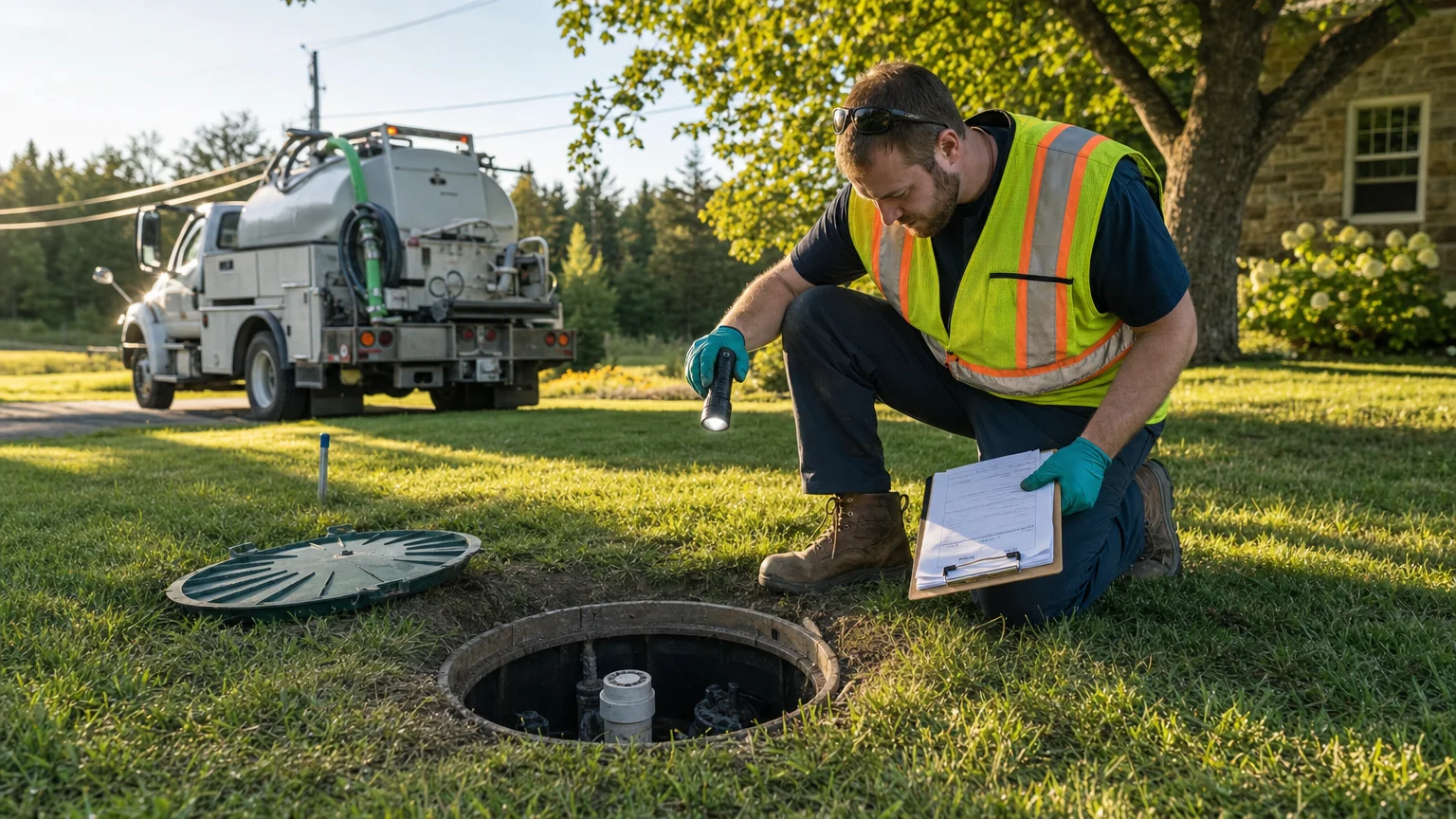
Roughly one in five Canadian homes relies on a private septic system rather than a municipal sewer connection — and in rural Ottawa, that proportion is considerably higher. Yet many property owners go years, sometimes decades, without scheduling a professional septic inspection, often discovering a serious problem only when sewage backs up into the home or the leaching bed fails entirely. Understanding what septic inspections in Ottawa involve, and why they matter, is the first step toward protecting both your property and your family’s health.
Key Takeaways
- A professional septic inspection evaluates the tank, baffles, distribution box, and leaching bed — not just the tank alone.
- Ontario’s Building Code Act and local health unit guidelines recommend inspections every one to three years, depending on household size and system age.
- Early detection of baffle deterioration, sludge build-up, or leaching bed saturation can prevent repairs costing tens of thousands of dollars.
- Real estate transactions in Ottawa increasingly require a septic inspection as a condition of sale.
- Combining an inspection with routine septic tank pumping in Ottawa maximises value and gives the inspector clear visibility inside the tank.
- A written inspection report is a legal and practical record that supports property sales, insurance claims, and permit applications.
- Neglected systems are a leading source of groundwater contamination in rural Ontario communities.
What Exactly Does a Septic Inspection in Ottawa Cover?
A professional septic inspection is a structured, multi-component assessment — not a quick glance into an open tank. The inspector examines every accessible part of the system to determine whether it is functioning as designed and how much service life remains.

The five core components assessed during a typical Ottawa septic inspection are:
- Tank condition and integrity — The inspector checks for cracks, root intrusion, and structural deterioration of the concrete or fibreglass tank walls and lid.
- Inlet and outlet baffles — These critical components prevent solids from entering the leaching bed. Deteriorated or missing baffles are one of the most common causes of premature leaching bed failure.
- Sludge and scum layer depths — Using a calibrated probe, the inspector measures how much accumulated solids remain in the tank. When sludge and scum together occupy more than one-third of the tank’s working volume, pumping is overdue.
- Distribution box (D-box) — The D-box routes effluent evenly across the leaching bed trenches. A cracked or unlevel D-box causes uneven loading and accelerates bed failure.
- Leaching bed condition — The inspector looks for surface ponding, unusually lush vegetation, odours, and soil saturation — all signs that the bed is receiving partially treated effluent or is hydraulically overloaded.
A thorough inspection concludes with a written report detailing findings, estimated remaining service life, and any recommended actions.
How Often Should Ottawa Homeowners Schedule a Septic Inspection?
The frequency depends on several factors, but a practical baseline for most Ottawa-area households is every one to three years. Systems serving larger households, older properties, or high-usage scenarios warrant more frequent attention.
| Household Profile | Recommended Inspection Frequency |
|---|---|
| 1–2 persons, system under 15 years old | Every 3 years |
| 3–4 persons, system 15–25 years old | Every 2 years |
| 5+ persons, or system over 25 years old | Annually |
| Property being listed for sale | Before listing |
| Recent heavy rainfall or flooding | Promptly |
The Eastern Ontario Health Unit and Rideau Valley Conservation Authority both advise property owners to maintain inspection records and act on findings without delay. Combining your inspection with septic tank pumping ensures the inspector has an unobstructed view of the tank interior — a meaningful advantage for accuracy.
What Are the Signs That a Septic Inspection Is Overdue?
Waiting for an obvious symptom before calling an inspector is a costly strategy. By the time sewage odours appear indoors, drains slow noticeably, or wet patches form over the leaching bed, the system has typically been failing gradually for months or years.
Warning signs that warrant an immediate inspection include:
- Gurgling sounds from drains or toilets after flushing
- Slow drainage across multiple fixtures simultaneously
- Sewage odours near the tank or leaching bed area
- Unusually green or fast-growing grass directly above the leaching bed
- Surface pooling of water or effluent in the yard
- A tank lid that has sunken or shifted
- Any recent backup of sewage into the home
If you are experiencing any of these symptoms, contact Rural Ottawa Septic’s emergency septic service rather than waiting for a scheduled appointment.
Why Does a Septic Inspection Matter for Ottawa Real Estate Transactions?
Property buyers in Ottawa and the surrounding rural municipalities are increasingly requesting — and in many cases requiring — a septic inspection as a condition of purchase. This reflects a growing awareness that a failing septic system represents a liability that can easily exceed the cost of a new roof or furnace.
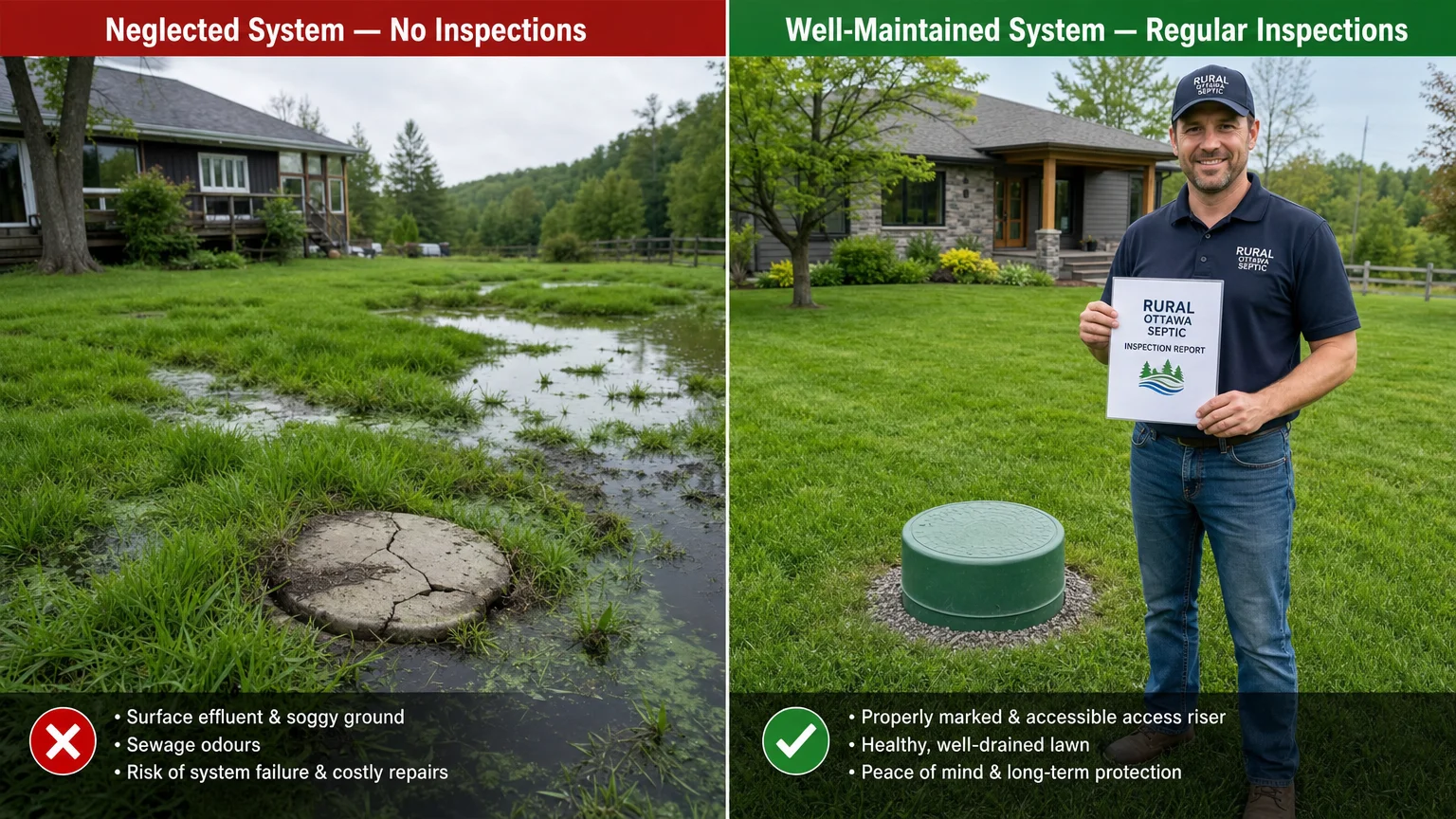
For sellers, a pre-listing inspection demonstrates transparency and can prevent last-minute price renegotiations. For buyers, it provides an independent assessment of a system that may have had minimal maintenance under previous ownership. Mortgage lenders and title insurers are also paying closer attention to septic system condition, particularly for rural properties in Lanark County, Carleton Place, Almonte, and the rural Ottawa townships.
A written inspection report from a qualified professional serves as documentation during negotiations and, if a problem is found, provides a clear scope of work for septic system repair or, where necessary, full septic system replacement in Ottawa.
What Happens After a Septic Inspection — What Are the Possible Outcomes?
Not every inspection ends with bad news. Many systems, when maintained properly, are found to be in good working order with only minor recommendations. The outcomes generally fall into one of four categories:
- Pass with no action required — The system is functioning correctly, sludge levels are within acceptable range, and no structural issues are present. Schedule the next inspection per the recommended timeline.
- Pass with maintenance recommended — The system is functional but would benefit from pumping, minor repairs to a baffle, or monitoring of a specific component.
- Conditional pass with repairs required — A component such as the distribution box or an outlet baffle requires repair within a defined timeframe. The system can continue operating while repairs are arranged.
- Failure — immediate action required — The leaching bed is saturated, the tank is structurally compromised, or effluent is surfacing. This outcome typically triggers a requirement to address the problem before the property can be sold and may involve septic design and permits in Ottawa if a new system is needed.
Understanding which outcome applies to your property allows you to plan financially and act before a manageable issue becomes an emergency.
How Do Ottawa’s Soil and Climate Conditions Affect Septic System Performance?
Ottawa’s geography creates specific challenges for septic systems that inspectors familiar with the region are trained to identify. The mix of clay-heavy soils in lower-lying areas, shallow bedrock in parts of the Canadian Shield fringe, and freeze-thaw cycles that can shift tank lids and distribution boxes all influence how a system ages and performs.
Spring thaw is a particularly high-risk period. Saturated soils reduce the leaching bed’s ability to absorb effluent, and frost heave can crack distribution boxes or displace risers. An inspection scheduled in late spring — after the ground has stabilised — captures any damage from the winter and sets a baseline for the warmer months of higher household water use.
Inspectors working in the Ottawa area also watch for the effects of road salt migration near rural roadways, which can accelerate concrete tank deterioration over time. These are region-specific factors that a generalist inspector may overlook but that an experienced local provider will flag as part of a thorough assessment.
Schedule Your Septic Inspection with Rural Ottawa Septic
A professional septic inspection is one of the most straightforward ways to protect a significant investment and avoid the disruption of an unexpected system failure. Whether you are maintaining a long-term residence, preparing to sell, or purchasing a rural property, having a clear, documented picture of your system’s condition is simply good stewardship.
Rural Ottawa Septic provides thorough septic inspections across Ottawa and the surrounding rural communities, backed by hands-on local knowledge of the soils, regulations, and system types common to this region. Contact us to book your inspection or to ask any questions about your system’s current condition.
Frequently Asked Questions
How long does a septic inspection in Ottawa typically take?
A standard residential septic inspection takes approximately one to two hours, depending on system complexity, how accessible the tank and distribution box are, and whether pumping is being performed at the same time. Larger or older systems with multiple tanks may take longer.
Does a septic inspection require the tank to be pumped first?
Pumping is not always mandatory before an inspection, but it is strongly recommended. An empty or partially emptied tank allows the inspector to clearly examine the walls, floor, baffles, and inlet/outlet pipes. Inspecting a full tank limits visibility and can result in missed findings.
Can I be present during the septic inspection?
Yes, and it is generally encouraged. Being present allows the inspector to walk you through findings in real time, answer questions, and point out components that require attention. You will also receive a written report following the inspection.
What does a septic inspection cost in Ottawa?
Inspection costs vary based on system size, accessibility, and whether pumping is included. Contact [Rural Ottawa Septic](/contact) for a current quote specific to your property and system type.
Is a septic inspection required by law in Ontario?
There is no blanket provincial law requiring routine inspections on a fixed schedule for all properties. However, local health units can order an inspection if a system is suspected of failing, and many municipalities require an inspection as part of real estate transfer or building permit processes. Staying current with inspections is the best way to remain compliant and avoid enforcement action.
What is the difference between a septic inspection and a septic assessment?
The terms are sometimes used interchangeably, but in Ontario practice, an *inspection* typically refers to a condition assessment of an existing system, while an *assessment* may also include soil evaluation and design work for a new or replacement system. If you are planning a new installation, [septic design and permits](/septic-design-and-permits) is the relevant starting point.
How do I find records of my septic system in Ottawa?
Septic system permits and as-built drawings are typically held by the local building department or health unit. For properties in the City of Ottawa, records may be available through the city's building permit archive. Your local Rural Ottawa Septic technician can also help locate the system on your property if records are unavailable.
Contributing writer at Rural Ottawa Septic.